Strong and Stretchy Metamaterials
MIT's double-network design
What are Metamaterials?
Metamaterials are specially designed synthetic materials with microscopic structures, making them both strong and stretchy. They are made up of specially designed materials with microscopic structures that enable them to have unique properties. Traditionally, creating a material stronger also makes it less flexible. This suggests that many strong metamaterials tend to be brittle and can crack easily. Led by Professor Carlos Portela, MIT researchers have finally discovered an effective method to resolve this trade-off. Their research was subsequently detailed in Nature Materials .
The Double-Network Design and Testing
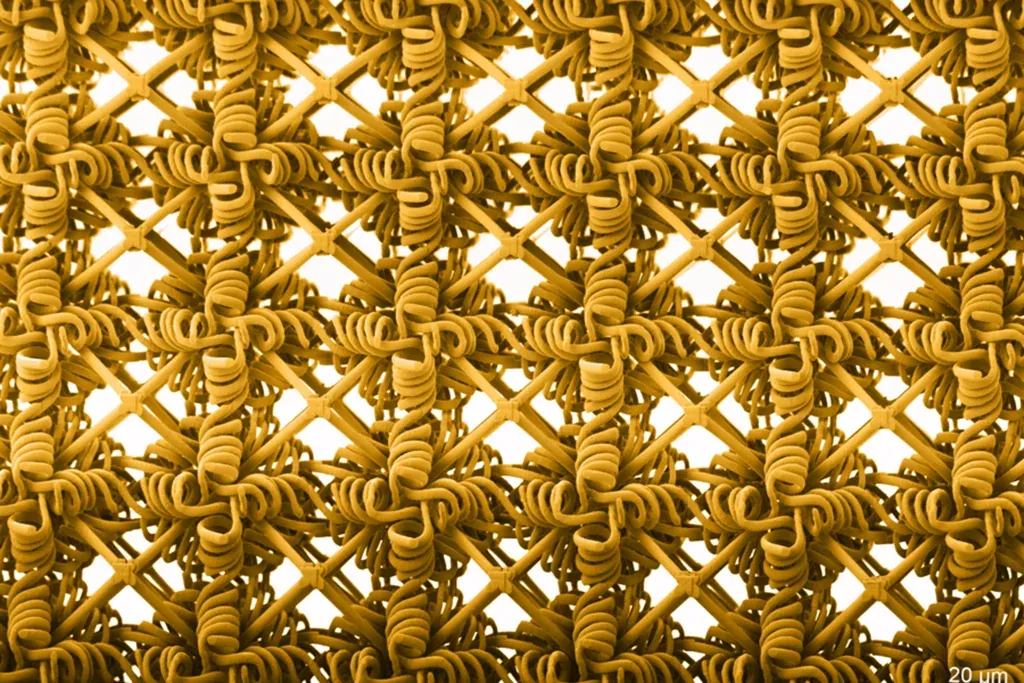
To overcome this situation, a “double-network” structure was created by the MIT team by combining and joining two different microscopic designs in one material. As the name implies, the design contains two distinct networks. The first network consists of a rigid lattice made up of minuscule struts and trusses. On the other hand, the second network was a woven pattern made of tiny coil s that were laced around each strut. Both networks were printed together utilising a special, high-precision method called two-photon lithography.
Researchers underwent a number of stress tests by attaching either end of the sample to a unique nanomechanical press, simultaneously measuring the force it took to pull the material apart. High-quality videos were also recorded to observe the locations and ways in which the material stretched and tore.
Observations
The new double-network design was found to stretch three times its own length and 10 times farther than a conventional lattice-patterned metamaterial printed with the same acrylic plastic. According to Portela, the material's stretchy resistance stems from the interactions between its rigid struts and the coiled weave when stressed.
“Think of this woven network as a mess of spaghetti tangled around a lattice. As we break the monolithic lattice network, those broken parts come along for the ride, and now all this spaghetti gets entangled with the lattice pieces,” Portela explains. “That promotes more entanglement between woven fibres, which means you have more friction and more energy dissipation.”
The soft material woven around the rigid structure takes on more stress because the broken, stiff parts create many knots and tangles. Since this stress doesn't travel evenly, a crack is unlikely to tear straight through the material quickly. Furthermore, the team learned that adding planned holes, or "defects," can help the material absorb and spread out stress even more, making it very stretchy and resistant to breaking at the same time.
Conclusion
With this groundbreaking discovery, MIT engineers have opened a new path in metamaterials research by creating a structure with a new design that is both sturdy and stretchable. They achieve a material that absorbs more energy and resists tearing by combining a stiff lattice with a softer woven network. There are basically more ways to make use of this material for real-life applications that can be beneficial for society.